I am a Master's student studying Mechanical Engineering - Research at Carnegie Mellon University, where I'm passionate about advancing the intersection of robotics and machine learning for autonomous systems. My work focuses on developing intelligent robotic systems that can operate reliably in complex, real-world environments.
Through my research and projects, I explore how machine learning algorithms can enhance robotic perception, decision-making, and control. I'm particularly interested in reinforcement learning and perception techniques that enable robots to navigate and interact with their surroundings autonomously.
A showcase of my recent work and research projects
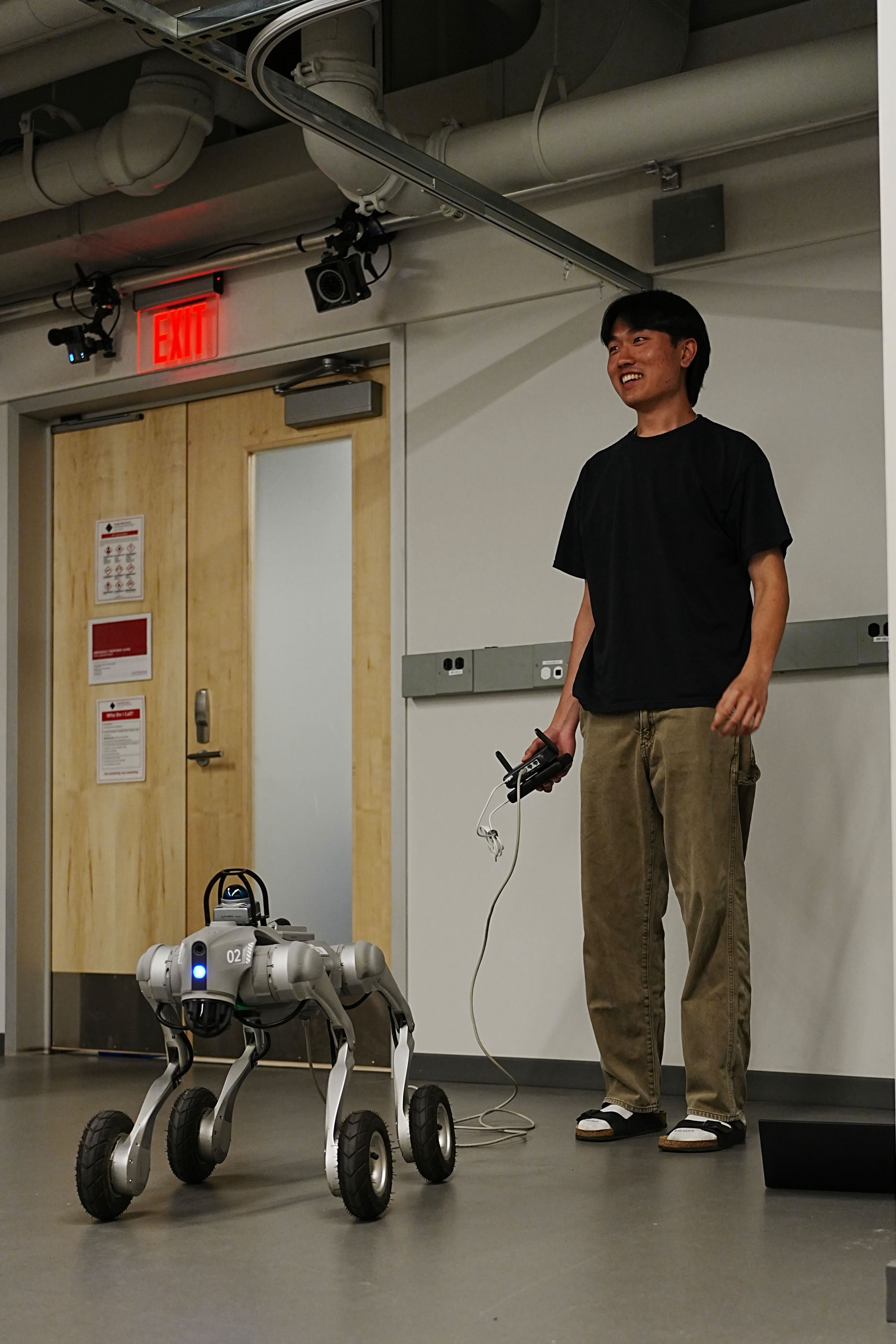
Mobile robots operating outdoors must maintain stability under terrain uncertainty and slip. This project develops a whole-body reinforcement learning policy for a wheeled quadruped that coordinates wheel and leg dynamics to improve stability across varying terrain conditions.
I built simulation environments in Isaac Sim and MuJoCo and trained a PPO policy with reward shaping focused on speed, stability, and slip reduction. The work emphasized understanding sim-to-real transfer challenges such as friction mismatch and wheel–ground interaction.
The policy achieved stable locomotion in simulation but degraded in real-world trials due to unmodeled friction losses and terrain irregularities. A systematic failure analysis identified simulation fidelity limits and informed future friction-aware modeling strategies.
My role: simulation design, reward tuning, policy training, sim-to-real failure analysis
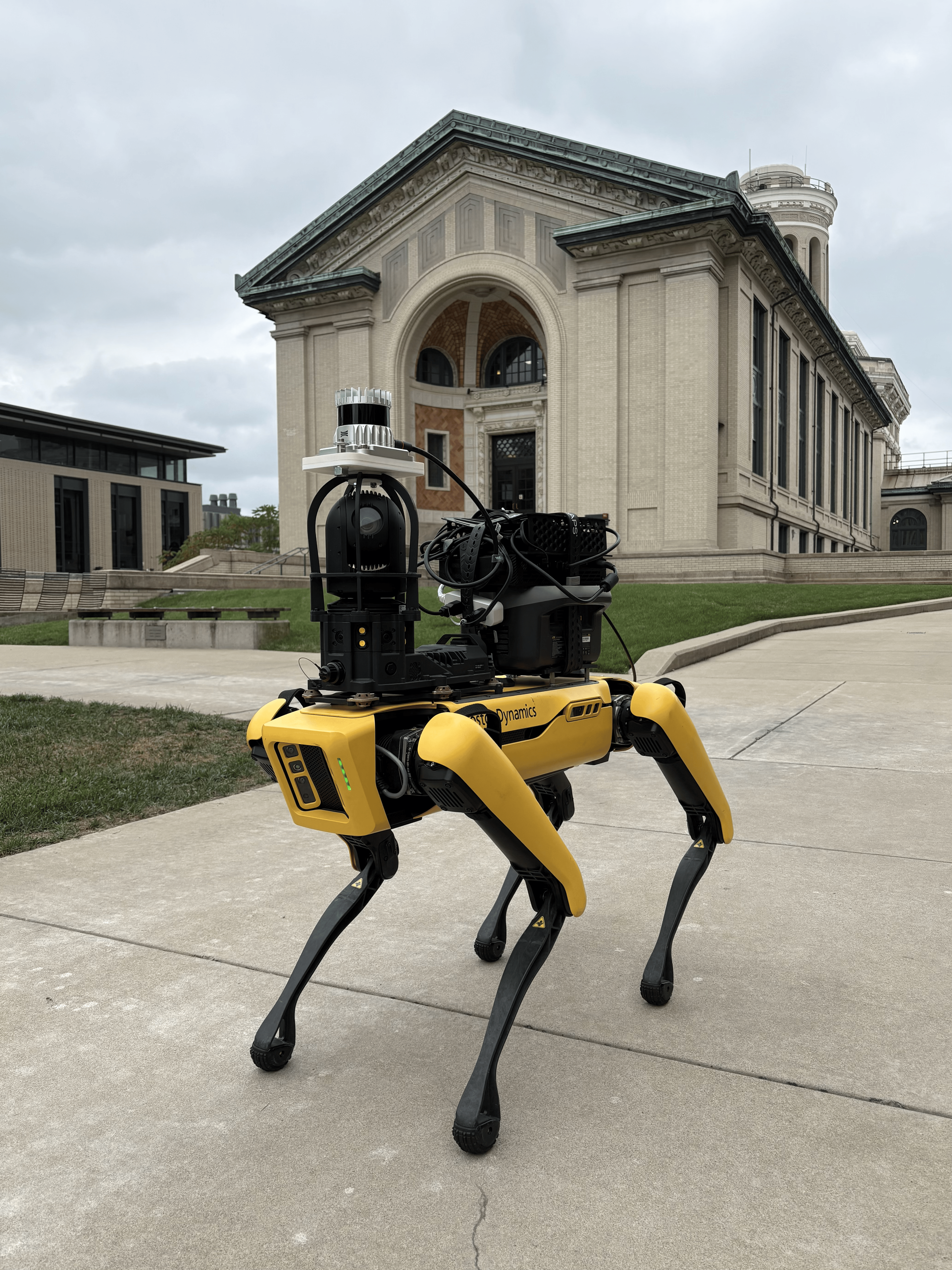
Reliable detection of dynamic obstacles is essential for safe navigation around people. This project designs a real-time dynamic object detection pipeline for Boston Dynamics Spot.
I implemented a hybrid perception pipeline combining geometric free-space clustering with a lightweight learning-based classifier to identify dynamic objects from LiDAR scans under real-time constraints.
The system achieved sub-100 ms inference while maintaining high precision across indoor and outdoor datasets. The hybrid design improved robustness compared to purely learning-based methods in cluttered environments.
My role: algorithm design, pipeline implementation, evaluation, real-robot deployment
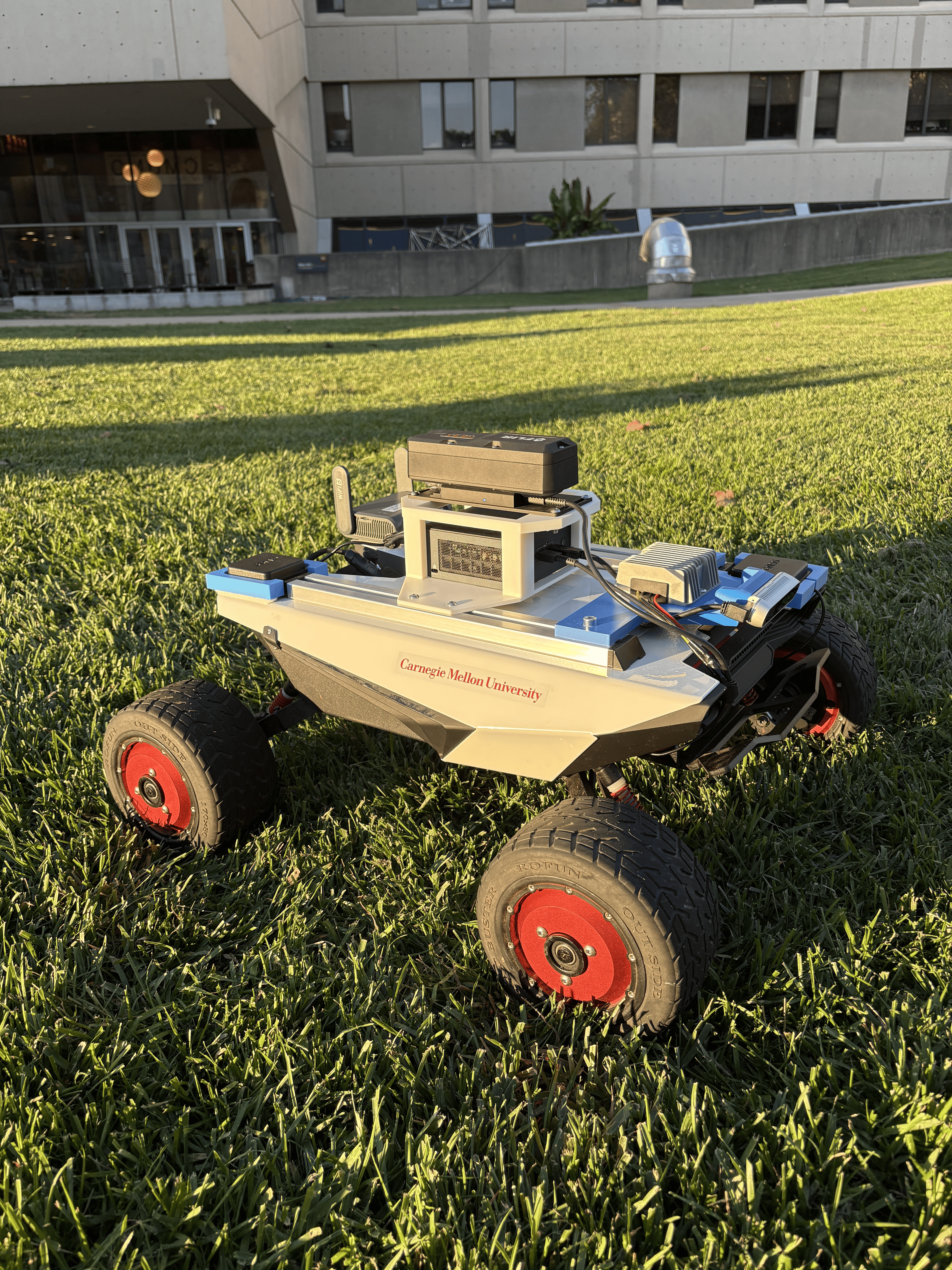
Autonomous gas monitoring reduces human exposure in hazardous industrial environments. This project developed a rover capable of waypoint navigation and real-time gas sensing.
I integrated a FLIR gas sensor, RTK GNSS, depth camera, and onboard compute on an AgileX Scout Mini. I developed a ROS-based navigation and obstacle-avoidance stack and built a GUI for telemetry and map visualization.
The system demonstrated reliable autonomous traversal and real-time gas data visualization in outdoor environments. The interface improved operator situational awareness during deployment.
My role: hardware integration, autonomy software development, visualization design
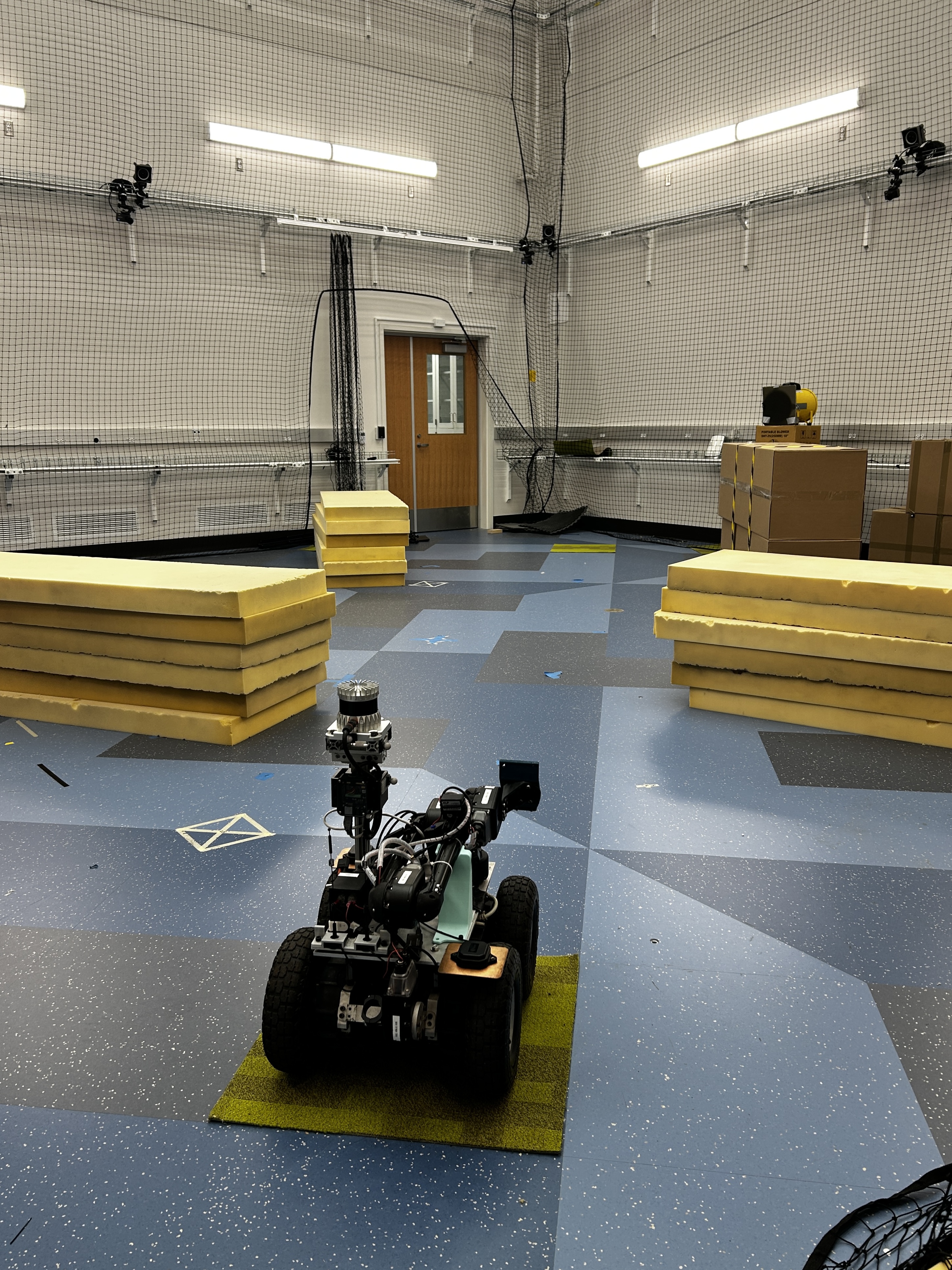
Accurate and efficient localization is critical for mobile robots operating in unknown or cluttered environments. This project applied LiDAR-based SLAM to enable reliable autonomous navigation on a rover platform under varying environmental conditions.
I implemented KISS-ICP as a LiDAR odometry pipeline within a ROS architecture deployed on a Rover Robotics platform. To improve navigation performance near obstacles, I experimented with adaptive speed control strategies that adjusted rover velocity based on local point cloud density along a predefined path.
The system achieved robust odometry and high-quality mapping across multiple environments while maintaining real-time performance. Adaptive speed control improved exploration efficiency near dense obstacles without degrading map accuracy or localization stability.
My role: ROS integration, LiDAR odometry implementation, adaptive speed control experimentation, system evaluation
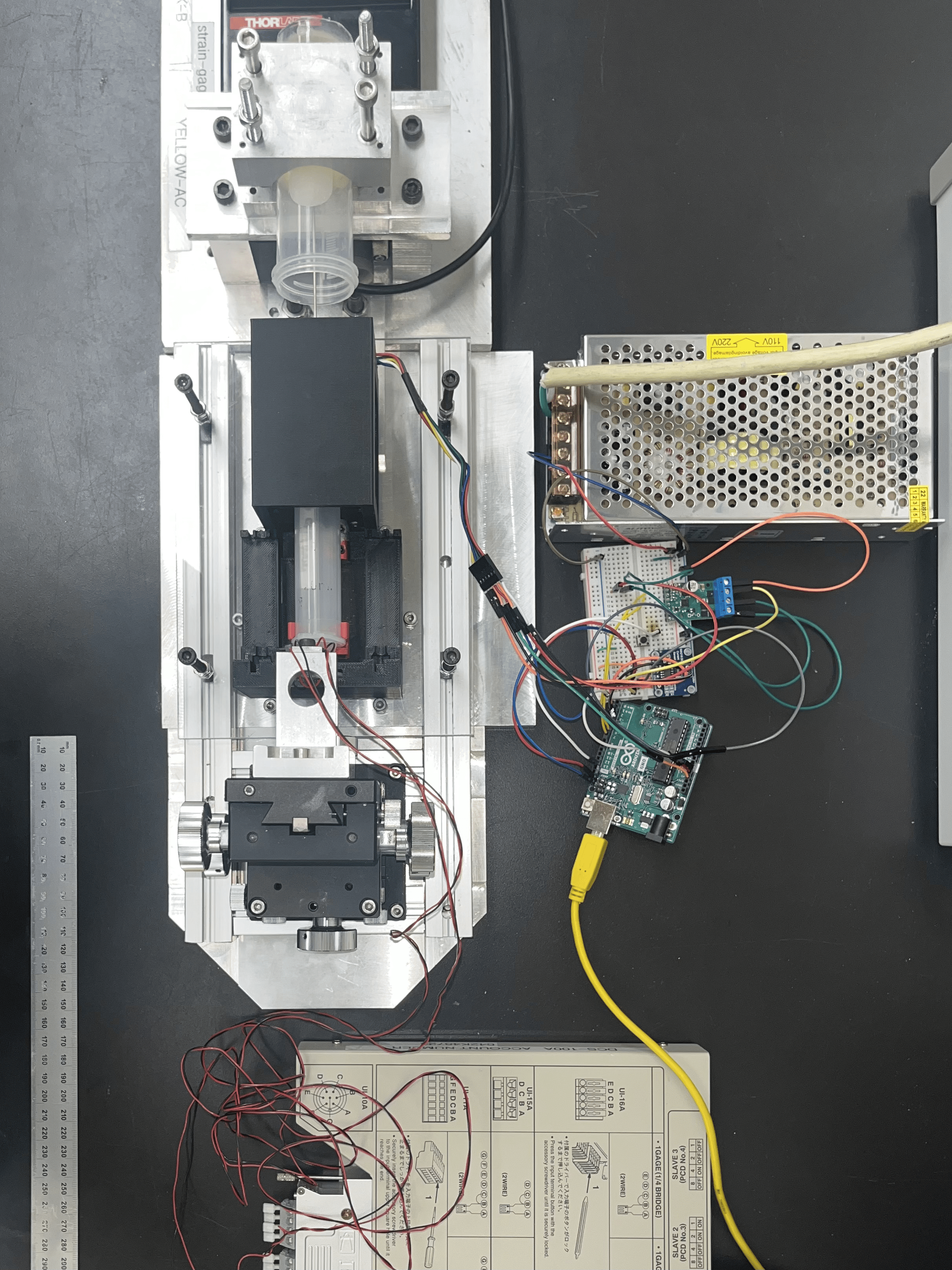
Improving biopsy sample yield can increase diagnostic accuracy for prostate cancer. This project evaluated an aspiration-assisted coaxial biopsy needle against commercial devices.
I designed and executed tissue-phantom experiments and analyzed force–stiffness data using encoder and strain-gauge measurements as part of an independent honors thesis.
The prototype produced biopsy samples 102% heavier than two clinical devices, with strong force–stiffness correlations (R² = 0.96 encoder, 0.94 strain gauge), demonstrating improved and consistent tissue acquisition.
My role: experimental design, data collection, analysis, thesis writing
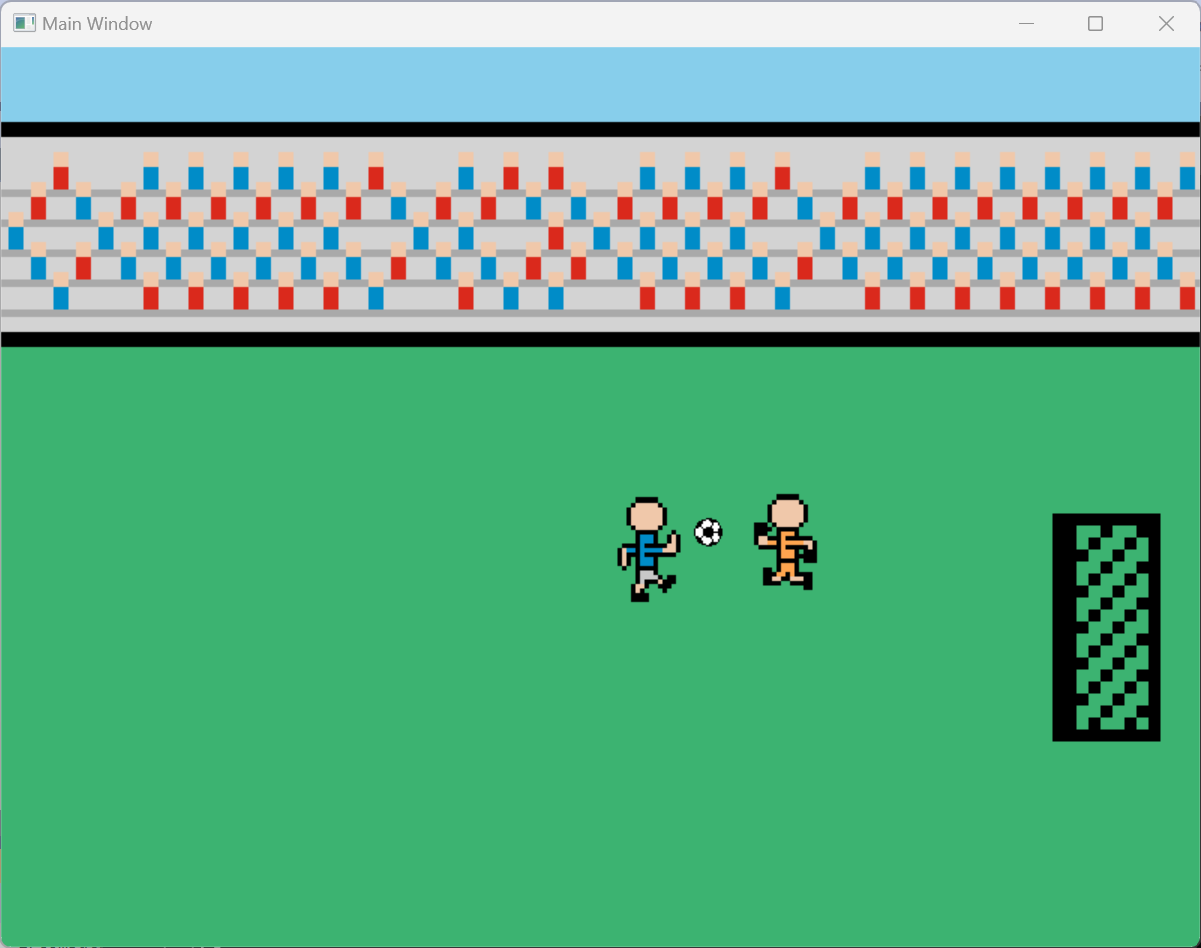
This project explores how low-level graphics programming can be used to create engaging, real-time visual experiences. The objective was to design and implement an original 2D animated demo that combines visuals, timing, and audio into a cohesive narrative.
I developed a soccer-inspired 2D pixel-art animation in C++ using custom OpenGL libraries. The demo choreographs a timed sequence in which a player advances the ball, interacts with an opponent, and scores a goal, synchronized with sound effects and scene transitions. The implementation required manual control of rendering, animation timing, and audio playback.
The program executed smoothly and delivered a complete animated sequence with coordinated visuals and sound. Among all student submissions, the demo was awarded 1st place, recognizing both technical execution and creative design.
My role: end-to-end design and implementation, including graphics programming, animation sequencing, audio integration